
Street-Smart or Street-Dead: The Choice Is Yours
The way you walk, move, and react tells predators everything they need. Make sure the message is clear: Not today
Inspired by John Farnam’s “Rules of Stupid” and real-life mugger insights, this edition draws from my Street S.M.A.A.R.T.S. framework and seminar, which I deliver to businesses nationwide– honed through years of coaching and urban threat training. We’re diving into dodging danger with the 7-Second Rule, criminal mindsets, resistance realities, and valuables protection to keep you safe.
Enjoy the video, even though Substack wants me to only provide a short preview, but I provided the whole clip. Spend less than the price of a good cup of coffee each month and become a paid subscriber.
The Rules of Stupid: Farnam’s Golden Trio
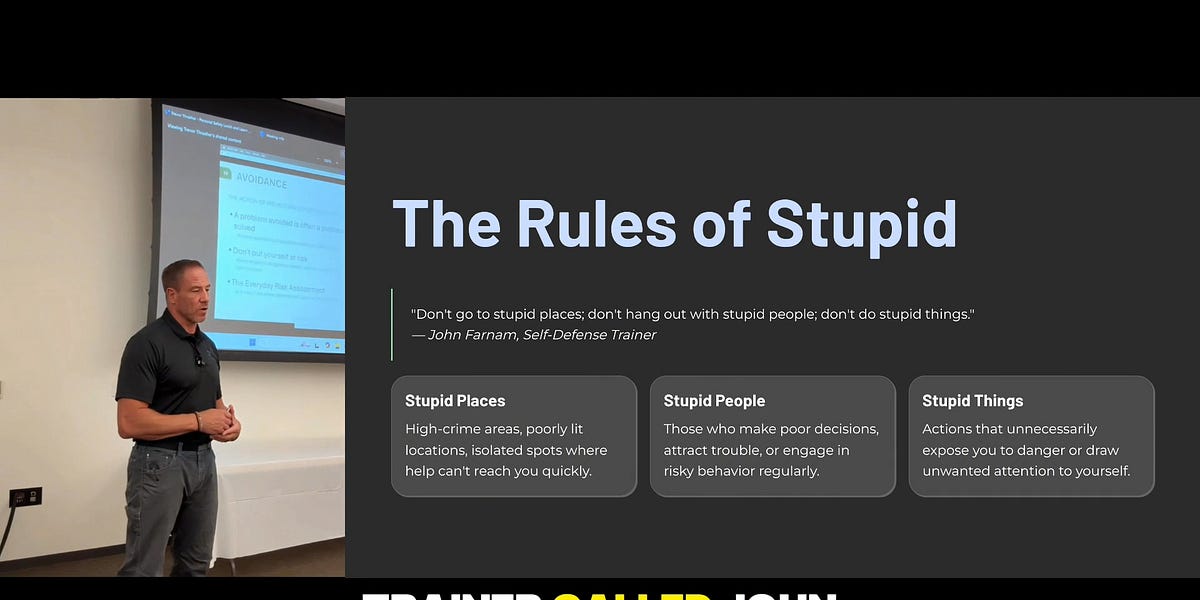
John Farnam’s Rules of Stupid
I give full credit to John Farnam for this one. He said:
“Don’t go to stupid places, with stupid people, doing stupid things.”
It’s funny, until it’s not.
Let me tell you about my cousin Todd. He once called me in a panic from a hotel room. Said a biker gang was after him. I asked what happened. Turns out he got drunk in Sturgis, ran his mouth to the wrong guy, and suddenly found himself in a real problem, stuck in a hotel room, far from home, with a Glock on the phone being chastised by me.
Todd took a class from me years ago where I literally taught this exact principle. He became a slide example—immortalized under the heading: “Don’t Be Stupid.”
The Foundation: Everything is Risk Assessment
Risk is everywhere. But so is choice. You don’t need to live in fear, but you do need to be honest about your environment and your behavior.
Going to a sketchy bar at midnight? Increased risk.
Carrying visible valuables while distracted? Increased risk.
Getting drunk with strangers in unfamiliar territory? Todd-level risk.
If you’re going to do something risky (and sometimes, let’s face it, fun), mitigate the danger:
Climbing? Wear a helmet and rope in.
Carrying cash? Use a decoy wallet.
Walking alone? Look like you’re hard to follow and harder to surprise.
Jumping from or climbing into helicopters, especially when doing so from or into water? Better do some rehearsals and equipment checks. By the way, that is one of my favorite pictures of my team in training, taken with just an iPhone.
You’re in the risk management business—whether you like it or not, and in the fun business too. Both have their place.
A problem avoided is often a problem solved. Follow everyday procedures to keep yourself and goods safe. Everything in life is a risk assessment. When doing things that are more dangerous (and often more fun), my simple advice is to mitigate the risk.
Understanding the Rational Criminal: Their Risk Assessment
Most criminals aren’t mindless—they’re rational actors running their own risk calculations. They evaluate potential targets carefully, choose optimal time and location, achieve surprise, assess your defensive capabilities, and only attack when success seems likely.
Read that last part again. They have conceived of all of your defenses and have planned around them and decided they won’t matter.
Their motivations? Obtain value with minimal effort, minimize personal risk and exposure, and escape without injury or capture. Deal with rational criminals if you must—they’re predictable. Irrational ones? Avoid at all costs; they’re the wild cards.
By flipping the script and red-teaming yourself like a criminal would, you spot your own vulnerabilities and adjust.
The 7-Second Rule: You’re Judged Fast
Criminals size you up in under 7 seconds, in much the same way that we make first impressions, evaluating four key factors:
Awareness: Head up, scanning, making appropriate eye contact.
Purposeful Stride: Strong, confident walk—slightly faster than others, not arrogant.
Confidence & Capability: Body language that says you can handle yourself without desiring confrontation.
Street Sense: Awareness of surroundings and personal space control.
If mobility’s limited by injury, fake it till you make it: Chest up, chin up, project strength without arrogance or cockiness. Studies confirm: They pick the unaware, unconfident, and weak-looking first.
Mugger Tactics: Know the Playbook
From real mugger confessions: They sometimes start with a test—like asking for the time—to drop your guard, then grab and demand. Targets? Alone, weak—elderly or women (but screams deter). Over 70% carry weapons at least some of the time.
Counters they suggest:
Distance & Movement: Answer from afar, keep walking—don’t break stride.
Noise: Whistles, air horns, or screams disrupt.
Mace: In hand, not purse—it’s painful and forces flight.
They believe fighting will mostly get you hurt more, and they are right, with some caveats. There is a lot of thought and moral decision-making that should go into resistance.
The Reality of Resistance
The critical question: What do you hope to achieve with violence?
Ask yourself:
Is your resistance going to work?
Do you truly have the capability to succeed?
Is it just going to get you more hurt?
(Unasked but implied) Is there a moral line where you accept the risk anyway?
Against a career offender, possibly armed? Odds are low for many. However, decide smartly—resistance may be a best resort, it is not always a last resort. With skill and precision, it may be the thing that saves you from further harm or the thing that stops dangerous criminals in their tracks.
Here is a feel-good story about an armed citizen taking out two robbers:
Some of the witnesses and citizens had mixed feelings about it, with some praising the man and others believing people should never engage or resist. Those who say never don’t understand that with freedom comes risk, in my opinion, a measured risk, but one nonetheless. As someone who has made that moral leap to risk my life for others far beyond any reward I could gain, I feel like we need more responsible defenders to do what our legal system often fails to do: take out the trash. Sorry, I meant to provide compassion and rehabilitation for those who are misunderstood. Again, there are caveats; weigh the risks from a legal, tactical, and moral standpoint. Having the capability for meaningful resistance gives you options at the very least.
On the other end of the spectrum, in the Bel Air follow-home robbery, risking life and limb, grabbing the cash led to a body slam and permanent injury. Comply if overpowered, separate from valuables, and escape, but have that back-up plan and capability ready.
Protecting Your Valuables
Your life is worth more than your property—keep that principle in mind. Risking safety for stuff often becomes a moral decision to accept more risk.
Conceal Expensive Items: Hide jewelry, electronics, cash—especially in high-risk spots. Avoid flashing wealth unnecessarily.
Strategic Positioning: Carry bags away from traffic, position phones and other valuables out of easy reach, keep purses zipped and close. Avoid easy-grab setups and let someone else be the target.
Prepare to Let Go: When confronted, immediately distance yourself from valuables. Instinct says grab; training says separate and survive.
Two resources worth your time: The Everyday Defender Guide covers the foundational principles every prepared person needs. The Street SMAARTS Personal Safety Certification formalizes your training with a structured, certification-backed course. Small investment. Serious return. Find both here:
Your Move: Red Team Yourself
Act like a criminal evaluating you. Spot weaknesses—slow stride, distracted scrolling—and adjust. Build awareness, confidence, and readiness into every step. I will have a lot more on the rules of resistance in the future.
Stay sharp out there.
Trevor Thrasher
High Threat Systems LLC


