
Chaos on Canfield Mountain: No Help Coming. What’s Your Plan?
In a world where chaos strikes without warning, the Tactical Twos give your family a no-BS safety plan to respond fast, regroup under pressure, and act when help can’t get to you.
In this post, I will reinforce the Tactical Twos: a basic family emergency response plan for nearly any crisis, and relate it to the recent ambush attack on firefighters in Idaho. This was a terrible and tragic incident, and our hearts go out to the people involved, especially the firefighters. The Tactical Twos is a checklist or planning guide based on special operations planning, simplified for everyday use. Just hitting a few points on the checklist can make you and your family 100% safer with 1% effort. It is a simple form of preparation for a more threat-proof family.
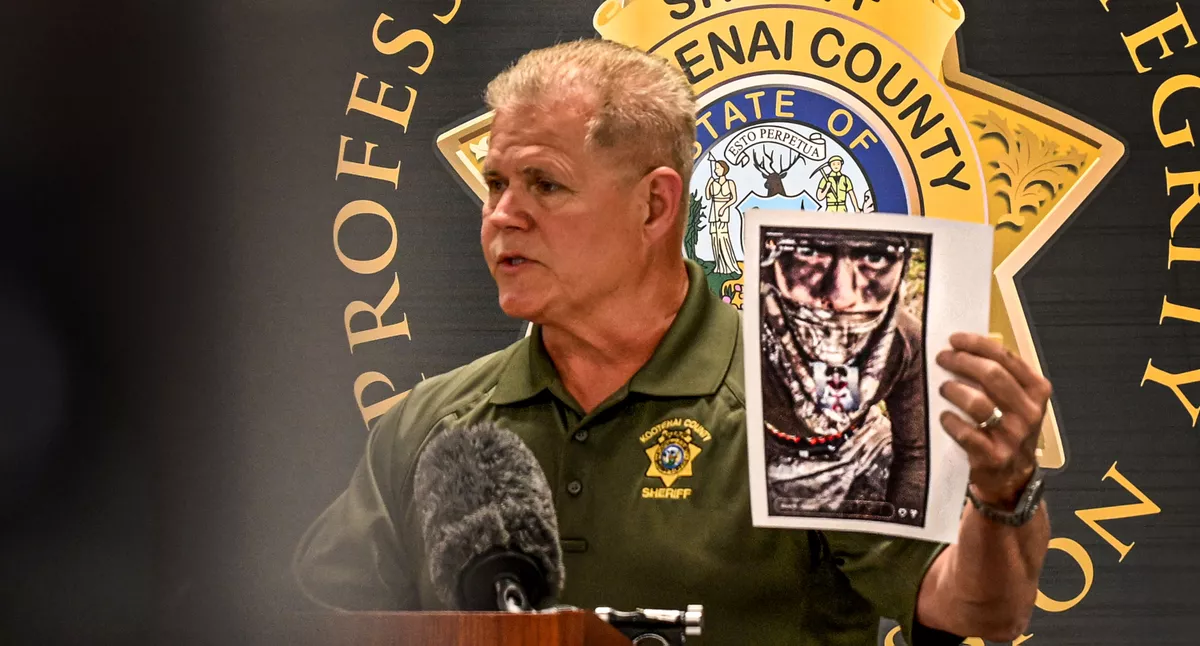
https://www.spokesman.com/stories/2025/jul/05/state-of-mind-of-idaho-firefighter-shooter-is-some/
You’re packing for a quick family trip—maybe a hike, a picnic, or a day in the city—and you think, “We’re fine, nothing’s going to happen.” Then you imagine what if that outing was near the firefighters in Coeur d’Alene, Idaho, who were gunned down in an ambush while battling a brush fire. Two dead. One in surgery. Police pinned down. The fire still raged, and the shooter was at large. The entire area was locked down, with the people you rely on for help too busy fighting to stay alive to look after you. It should hit you like a punch in the gut… if you know your family isn’t prepared.
This is a result of the Hybrid Threat Environment (HTE), a term I coined to describe the chaos crashing into our lives: drugged-out and emboldened criminals, demoralized cops, rogue prosecutors, mental breakdowns, fractured families, and ideological violence amped up by media panic and online echo chambers. We will face more of this—targeted attacks, random horrific crimes—no one is entirely safe. The impact is like a terror attack delivered in small, steady doses.
Most people think personal and family safety is something that can be completely outsourced. They believe, “We’re good people,” or “We’ll just call 911 and everything will be okay.” They’ve never taken even a minute to talk with their family about what they’d do if a gunman opened fire nearby. They’ve never rehearsed a plan, never carried a kit, never even looked for an exit.
Why Parents Aren’t Ready—And Need to Be
Moms and dads, you weren’t raised for this. Parks and malls used to be safe. But now we live in a time where terrorists firebomb charity walks, trucks plow through crowds, and gunfire breaks out at parades.
You’re not failing. The world changed. But you can adapt. And it doesn’t take much. The Tactical Twos are a 1% effort for 100% more safety. They cut reaction time. They keep everyone accounted for. They let you act when no one else can, by yourself, with your family, or with a team.
Imagine two families near that area in Idaho. One never in a million years believed something like this could happen.When the shooting starts, panic sets in.Maybe they’re separated. Perhaps they freeze, focused solely on what is happening to them instead of what they need to do to get out of the situation. Perhaps they become trapped in the doom loop of “this can’t be happening” and have nothing in their memory banks to guide them on what to do next.
Compare that with a family that has an intact sense of survival. They have discussed how to respond to a crisis like this, have even taken the time to train in a few important skills, have a trauma kit, and have made just a few adjustments to their usual plan when going out or attending an event.Preparation replaces panic, focused replaces fear; they all recognize what is happening for what it truly is, and they act as a team.Their training and just a little bit of planning guide them to survive and prevail when others would fail.
We witnessed the consequences of a lost sense of survival during the Boulder fire attack. Most of the victims and bystanders were in shock, frozen in place. Very few people acted in a way that improved their situation. They had no concept of how to deal with the threat or get themselves to safety. A few probably handled themselves well—but most were unprepared, lacking even the basics of crisis response. That’s not judgment. It’s a call to action.
It can really be that black and white, but there is also some gray area in the middle. Can you afford not to take reasonable steps to protect your loved ones? A little training, planning, and preparation can go a long way. It is never about being 100% safe; it is about putting the odds more in your favor and looking for easy wins to make you 100% more threat-proof.
Let’s go over some notes and key points based on incomplete and early information from the event:
I just finished teaching a two-day Officer Safety course, and we focused heavily on ambush attacks. Depending on the dataset, ambushes and unprovoked attacks now account for up to 30% of officer fatalities (2022 Data), rising from roughly 10% per year during the 1980s (DOJ, Ambushes and Unprovoked Attacks, 2018; Improving Law Enforcement Officer Safety and Wellness Through Data Act, 2023)
One-third are planned entrapment situations (IACP Ambush Fact Sheet, 2011), which seems to be the case for this event. Officers caught in an ambush are 6–8 times more likely to be killed. Firefighters are nearly defenseless.
Unfortunately, as I always say in counter-ambush classes, you can order the cops (or any emergency services) up like pizza: “send me a couple of city cops and a side of country right to my front door, please.”Unfortunately, cops must accept that risk; firefighters shouldn’t have to.
Attacks on firefighters, unfortunately, aren’t new. But they are certainly one of the most cowardly acts you can think of. Targeting people who would risk their lives only to help you is an evil act. Our memories are short, but here are a few examples of previous attacks on firefighters:
Appleton, Wisconsin: Firefighter killed by drug suspect whose life he just saved
Webster, NY (2012): Gunman Ambushes, kills Two Firefighters in New York Blaze
Boston, MA (2024): Person Arrested Shooting at Firefighters Putting Out Blaze
In the Idaho case, the 20-year-old shooter was eventually identified and was armed with a shotgun. Early reports claimed multiple shooters and a “high-powered sporting rifle.” Here’s a hard rule:initial info will almost always be wrong in a significant way. Fear hijacks perception, and under stress, we’re wired to assume the worst.Police, expecting more than one attacker and trained to focus on eliminating threats, will bypass victims and be preoccupied with looking for ghosts. That means that even if they are in the scene, you will have to look out for yourselves initially.
In wooded areas, determining the source of shots is extremely difficult. I’ve taught a Rural Ops Course repeatedly to US Marshals and other units.One of the main points was to demonstrate how challenging it is to pinpoint the exact location of a person firing. Another main point was how difficult it is to keep track of all the people in a wooded area.
Movement is easier to detect than someone lying still.A stationary person with even minimal concealment can disappear completely and has a huge advantage.
If you can break line of sight quickly—say with a building, hill, or dense cover—running hard might still be your best option. But if you’re caught in a wooded area without clear cover, that tactic can get you lit up. In that case, get low, go slow, and be quiet. Use low ground, trees, or brush to hide. Your goal is to carefully maneuver to terrain that will block the line of sight to the probable shooter’s location; then you can move quickly and exit the area. Sometimes the best move is to crawl to the nearest concealment and wait it out. Speed has its place, but at the wrong moment, it’s a bullet magnet.
The Tactical Twos: Your Immediate Action Plan For Any Crisis
The Tactical Twos are built on the Special Operations principle of redundancy: two is one, one is none. That means you need two ways to do anything critical—two ways to alert, escape, hide, fight, and aid. You need two tools ready to perform each action. A flashlight and a pen. A trauma kit and a scarf. A code word and a shout.
This isn’t just for mass shootings. The same prep applies if the power goes out, your kid gets separated at a festival, there is a car accident, or someone has a heart attack in a crowd. It’s SOP—Standard Operating Procedure—for life.
Much of this checklist can remain relatively the same for various events, and you will only need to brief on the changes or refresh everyone’s memory. Relatively safe events require less planning, such as a family trip to Costco. More complex or high-risk events, like a Super Bowl parade, may require a bit more planning.
Here are the basics of the plan applied to a similar event: alert, run (evade), hide (barricade), fight, and aid.
Remember, this Substack will thrive with a 1% effort from you to become a paid subscriber. Operative Level subscribers will get access to the entire Tactical Twos Program in short order. Membership has it's beneffits.
I believe the Tactical Twos Crisis Response Planning System QuickStart is probably my biggest bang-for-the-buck course. I charge almost nothing for it. You can find it here: Tactical Twos Crisis Planning Quickstart
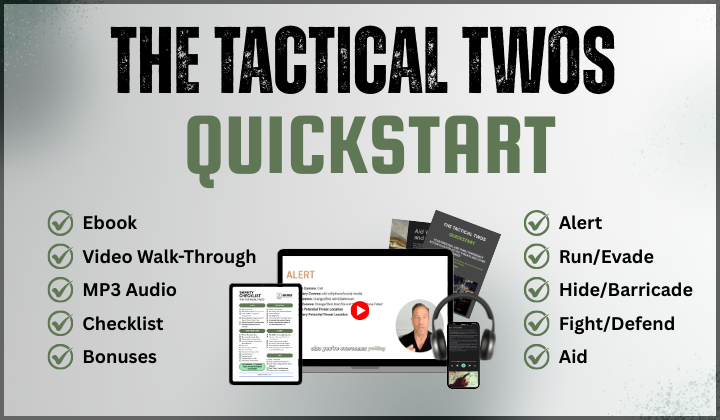
If you just want the checklist, click here: Tactical Twos Checklist
Alert
Gunfire might not raise eyebrows in some rural areas, especially during hunting season or near the Fourth of July. That’s exactly why it’s dangerous. In almost every active shooter event, witnesses say they thought the shots were fireworks, construction noise, or something else mundane—until it was too late. That delay can cost lives. If something doesn’t sound right, don’t waste time trying to make it fit your normal. Have a pre-set “Red Alert” signal—verbal, text, or both. A family group text thread or walkie system should be SOP. One word—fast response.
Run/Evade
I’ve already given you the rundown on how to move low and smart when pinned, but ideally, you don’t get caught in the open. That’s where rally points come in. You need two. The first is near—usually your vehicle or a location nearby. The second is far—someplace outside the kill zone and out of sight. It could be a shop, a landmark, or another predetermined spot, a couple of blocks or terrain features away. Make it part of the plan. If people get separated, they need to know where to go, how to regroup, and how to account for each other.
Hide/Barricade
In this case, authorities issued a shelter-in-place. That doesn’t mean you just sit and pray. Know in advance at least two spots where you can lock down and deny entry—could be a restroom, a closet, a storage room, or even a utility shed. Practice basic barricading techniques. Stack furniture. Wedge doors. Shut off the lights. And always ask yourself: what if the shooter goes mobile or tries to break in? Always be ready for the next option.
Fight
Fighting is a tactical decision—not a last resort, not a fantasy. If you only think of it as a last resort, you may miss the times when it is the best resort. Mental readiness matters. So do tools. Pepper spray, a knife, flashlight, or firearm—if trained and legal—can make all the difference. During the Idaho attack, the sheriff put out a plea: if anyone had eyes on the shooter, take the shot. Cue the internet tough guys. Social media lit up with chest-thumping about skill, gear, and fantasy heroics. But almost none of them considered how they’d appear to responding officers. Rifle in hand. Unknown threat. Confusing scene. You’re suddenly the target.
Misidentification isn’t theory—it’s history. Look at Johnny Hurley, a brave citizen who stopped a mass shooter in Arvada, Colorado, only to be mistakenly killed by police:
🔗NBC: Colorado Officer Won’t Be Charged in Shooting of Hero Civilian
I’m not saying don’t act. I’m saying act smart. Visualize what you’d look like through the eyes of a stressed-out cop arriving mid-gunfight.
Aid
This could have been the most critical piece of the Idaho incident for a family trapped the gunfire. First responders were pinned down, and medics had to stage at a safe distance. That means anyone shot was bleeding out alone. A trauma kit—even a mini one on your ankle—can save a life. You don’t need to be a paramedic. Just learn how to stop bleeding and make a hasty tourniquet. If you’re carrying a gun without medical training, your priorities are backwards.
Severe bleeding is the most preventable cause of death from gunfire, accidents, and even disasters. Take aStop the Bleed™class—it’s often free, quick, and offered all over the country. Then make sure your kit isn’t locked in a glovebox you can’t reach. An ankle kit, belt kit, or purse-sized pouch works just fine. Small effort. Big payoff.
Is This Too Much to Ask?
Some of this should be SOP (Standard Operating Procedure) for daily life. Rally points, trauma kits, comms, code words—they help in any emergency. Power outage. Tornado. Medical scare. A few hours of training. A few extra tools. A quick plan. This is 1% effort stuff that makes you 100% safer.
You don’t have to be paranoid. You just have to be ready.
Prepare. Practice. Prevail.
Trevor Thrasher
High Threat Systems | Grey Group Security


