Don’t Open That Door! How to Survive a 2 a.m. Killer’s Knock
Surviving Targeted Attacks: Awareness and Action in a Hybrid Threat World
We live in a hybrid threat environment—a place where ideological killers, opportunistic criminals, mental health and social breakdown, handcuffed police, and unprepared citizens collide. The world’s gotten strange. People have lost their survival sense, and now they need it more than ever. Most have never even considered what they’d do if someone knocked on the door at 2 a.m. with bad intentions. They think being nice or living in a nice neighborhood is enough.
This piece builds on what I covered in my last blog post about hybrid threats, modern violence, and failed mindsets during the Boulder terrorist fire attack. If that one was a wake-up call, this one is your first field exercise. Because what happened to a group of Minnesota lawmakers wasn’t random—it was methodical, brutal, and exactly the kind of attack we’re going to see more of. I have spent quite a bit of time on home defense and ruse defense in articles and blogs here: https://highthreatsystems.com/blog
Here is a short video on a method to open a door relatively safely in the rare chance you need to do it:

Incidentally, this event occurred only days after I finished a “High-Threat Close Quarters Contacts Course” for police officers in the area. This course included several officers from Brooklyn Park, Minnesota, which was the agency involved in the gunfight with the suspect.
The Timeline: A Night of Terror, Resilience, and Chance
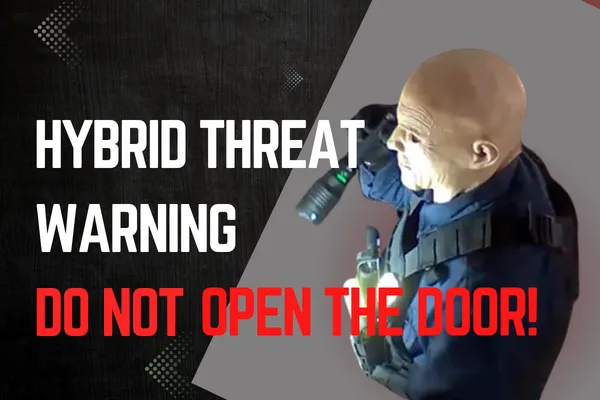
The nightmare began around 2 a.m. on June 14 in Champlin, 20 miles northwest of Minneapolis. Boelter, wearing a black tactical vest and a flesh-colored mask, knocked on the Hoffmans’ door, shouting, “This is the police. Open the door.” Both John and Yvette came to the door, opened it without verifying his identity, and missed the mask. Realizing he wasn’t a police officer, they confronted him, but Boelter shot John nine times and wounded Yvette. Their daughter was able to close the door and called 911 at 2:06 a.m., reporting the attack. Mistakes were made for sure, but let’s honor their resilience.
By 2:24 a.m., Boelter arrived at a legislator’s home in Maple Grove, 10 miles away, ringing the bell and claiming, “This is the police. We have a warrant.” The legislator was absent, and Boelter left. At 2:36 a.m., a New Hope officer spotted Boelter in his SUV—fitted with fake lights and a license plate—parked near the home. Mistaking it for a police vehicle, the officer approached, but Boelter stared down and didn’t respond. The officer checked the house, found no distress, and waited for backup, but Boelter had already slipped away—a catastrophic lack of awareness.
Around 3:30 a.m., Brooklyn Park police, acting on a sergeant’s hunch to check lawmakers, found Boelter at the Hortmans’ home. He fired into the house, killing Melissa and Mark and gravely injuring their dog. Officers engaged him in a gunfight, forcing him to flee into a wooded area, abandoning his SUV with five firearms and notebooks listing 45+ officials. At 6:18 a.m., Boelter texted his family, “Dad went to war last night,” and warned his wife of armed responders. By 7 a.m., he had bought an e-bike for $2,200 from a man at a bus stop, then a Buick, wearing a cowboy hat, which was captured on bank cameras.
The manhunt peaked on June 15. A citizen reported Boelter on an e-bike near his Green Isle home, leading police to the Buick, which contained a letter to the FBI claiming responsibility. At 9:10 p.m., another citizen noticed him standing alone in a field, refusing eye contact unnaturally—key awareness indicators. Police captured Boelter without force as he complied and announced himself. The killers' final capture was enabled by two highly aware and responsible citizens. This is the kind of police work that I love, where the community and their law enforcement officers come together to solve a problem, working as a team. This is the way.
Mindset Rules: Your Foundation for Survival (Again)
I usually repeat these mindset principles for almost every post. Mindset serves as your fundamental layer of survival, and the failures often become apparent. We have fallen into a pattern of blind compliance and victimhood. For most, life has been too easy for far too long; it is only recently that a significant number of people have been able to live without adhering to these rules. Times have shifted. The statistics might be in your favor for now; you might never truly need to defend yourself. However, if you find yourself on the wrong side of those statistics, relying only on hope or calling 911 might be your demise. Being able to provide for your defense and the defense of your family to a reasonable degree should be a primary directive. Anything else is simply irresponsible. Put these rules on your refrigerator next to your kid’s artwork!
Rule #1: No matter how you live your life, you may be attacked for a variety of reasons. Boelter targeted lawmakers for their politics—your stance can make you a mark. Ideological violence is the new norm. It doesn’t matter if you are a politician, a CEO, going on a fundraising run for kidnapped victims, or happen to work at a Tesla dealership.
Rule #2: Safety is your responsibility, not anyone else’s. Outsourcing it to Hope or 911 isn’t enough. Your defensive plan should never rely on someone else doing everything perfectly or even correctly; this includes the police.
Rule #3: Give yourself permission to act. Discuss safety with your family, train, practice drills, and master defense with your hands or tools. This isn’t paranoia; it’s how humans survived and thrived until recently.
Don’t Open the Door to See Who Is There!
When it comes to someone knocking late at night, two simple rules:
Don’t open the door.
Don’t open it with a gun in your hand.
Statistically, yes, it could be a cop. But impostors exploit that. Criminals don’t need to overpower you if they can outsmart you. We are creatures of habit and panic. When someone yells "Police!" at your door, your instinct is to obey. But instincts can be reprogrammed.
Today, there’s no excuse not to have a door camera or peephole. The idea of first opening the door, and then seeing who it is? Delete it from your brain. See who it is, check the surrounding area for accomplices, then make a deliberate, informed decision to open the door. Even if it is the police, the time to verify is before the door opens. And never open with a gun in hand—you could be shot before saying a word.
Here’s what you do instead:
Go to a calm Code Orange – everyone in the house goes into temporary readiness mode. Don’t panic. Just pause, assess, and be ready for a short moment.
Grab a phone and a defensive tool – no excuses. Those should be accessible.
Observe from a safe position – upstairs, a side window, anywhere but right in front of the door. Be sure to examine the surrounding area.
Interrogate and verify – "What agency? What do you want?" Call 911 to confirm. Real cops won’t argue with that.
Is It Really the Police? How to Verify Without Getting Duped—or Shot
As with anything awareness-related, start by comparing what you’re seeing to your baseline. Does this person appear and behave like a legitimate law enforcement officer? If something feels off, pay attention to that gut instinct.
Here’s what to look for:
Uniform and vehicle – Are they wearing a marked, consistent uniform and badge you are familiar with? Is there a visible, marked police vehicle parked as you would expect? Both can be faked, so don’t stop there.
Police radio – Legitimate officers almost always have a working radio on them. That’s an intricate detail to replicate convincingly.
Body language – Are they trying to obscure their face from your door camera or wearing a mask? That’s a red flag.
Hands and gear – Look for suspicious items, such as zip ties, masking tape, or bags, rather than standard-issue police gear. These are tools of a home invader, not a cop.
The failsafe method? Tell them to wait and call 911 yourself. You’re not being difficult—you’re being responsible. If they’re real officers, the dispatcher can confirm it. If they’re not, you just bought yourself time and possibly saved your life.
From a safe position, you can interrogate the person through the door:
“What agency are you with?”
“Why are you here?”
“Can I see your badge?”
Don’t be pressured to open the door, no matter how loud or demanding they get. Delay is your ally. If they have a warrant and are going to make entry, first, you need to ask how you got yourself into this mess in the first place, and make sure you stay calm. Professional police departments make the knock-and-announce process very obvious, including the use of marked cruisers in a conspicuous position, as well as sirens, lights, and announcements. Typical bad guys do not want that type of attention.
If they resist or get evasive, assume the worst. Alert your family, use your code word, and get to your safe area. Do not open the door to challenge them. And avoid visibly brandishing a firearm through the peephole or window, especially if they turn out to be real police. That mistake has gotten people killed—more on that next.
If you sense an intruder and a ruse, you may consider getting to a good spot to defend the door and warning the person outside, saying something like, “Stop! I am armed, and the police are on their way! Leave now!” I hate to admit it, but I took that general phrase from Navy SEAL Larry Yatch. This should prompt any genuine police officer to pause, and the line about calling the police should indicate that you are not the bad guy. If they are rational bad guys, they would be smart to leave immediately. Nothing is perfect; there are other possibilities, but this is a good baseline.
Don’t Open It with a Gun in Your Hand
The second thing you should never do is open the door with a gun in hand. It amazes me how often I’ve tried to argue with individuals about this, who emphasize that it is their right to own a gun in their home and open the door with it. However, it’s not the smartest decision to display one and open the door to your home when you don’t know who is out there. There is no tactical advantage in giving your enemy an easy shot at you and an easy entry into your home; furthermore, no reputable tactical trainer would advise you to do so. Despite your visions of how tough you are and how you’ll scare everyone away, this is simply not the case.
As far as I can tell, people who think this is a good idea have never taken the time to consider their tactics ahead of an incident. I would suspect that in many cases, they are filled with more bravado than training or common sense. Defending your home and loved ones is honorable, but you need to consider these situations carefully. Typically, there are one or two instances every year where a homeowner comes to the door with a firearm and gets shot by the police. Most often, these shootings are later deemed awful but lawful, and everyone suffers… needlessly.
Here is a tragic example out of Farmington, New Mexico, where officers arrived at the wrong address and an innocent father was killed in front of his family. After the police knocked on the door and announced who they were, the father cocked his gun behind the door then opened it aggressively and pointed a handgun at the officers. Even worse, his wife, believing the police were intruders, was also nearly killed after she fired shots at them while defending her mortally wounded husband. I feel sorry for this poor family, and I am doing what I can to prevent similar incidents from the homeowner’s perspective.
https://www.youtube.com/watch?v=qX5AnYvwR9w&t=236s
This loss from these incidents is easily avoidable. This incident is a prime example of my 1% - 100% rule. If this family had just taken 1% of their time to rehearse common home defense situations, maybe even just enough to read this article, they could have been 100% safer. You can blame the police all you want; anyone can get an address wrong, but you are responsible for your behavior. Your defensive plan should never rely on someone else doing everything perfectly or even correctly; this includes the police. Responsibility is more important than blame. Unfortunately, society seems to have that reversed.
A gun is only a tool, and without a good plan or practiced tactics, it can be a liability. There have even been some horrific cases where officers shot people through windows because the police saw them with a firearm while investigating incidents such as a burglary at the home. Those incidents demonstrate the wide and unpredictable variety of police competence you can expect. I am also doing what I can to address that issue.
I’m not asking for much here—just some common-sense safety procedures. If you have a gun in the home for protection, have you taken a few minutes to review the tactics you might use in expected situations and practiced them? I live in a nice, low-crime neighborhood with neighbors all around me who have visibility to my front door, but if a stranger comes, we abide by these rules. I have also stayed in houses in areas of the world where I had to plan on being assaulted by terrorists in the middle of the night. I had a plan for each situation. Keep in mind that a gun locked in a gun safe in your master bedroom probably won’t be much use if someone’s trying to breach your door. That’s a whole other subject about where to store firearms in your home.
Police Missteps and Wins
The New Hope officer missed every cue: the fake SUV, Boelter’s refusal to engage after a shooting alert. That’s a lack of awareness that let a killer walk—your plan can’t depend on others’ perfection. Contrast that with the Brooklyn Park sergeant’s hunch to check lawmakers, sparking a gunfight that forced Boelter to ditch his ride and weapons. That’s wisdom and initiative, saving lives.
Final Thoughts
This was a ruse. It worked. It cost lives.
Criminal ruses are like scams—they rely on:
Urgency
False authority
Emotional manipulation
They bait you into giving up your position. Into hesitating. Into trusting the wrong person at the wrong time.
You don’t need to be paranoid—but you do need to be ready. Harden your mindset. Train your family. Know your procedures.
I go into all of this in more detail in my Threat-Proof Family program and in my Street Savvy Pro e-guide. Links below. Start there. Then take action.
Because when the knock comes—you won’t get a second chance.
Want a step-by-step guide to make your family 100% safer from active threats and other crises? Learn more here:
Stay sharp,
Trevor Thrasher
High Threat Systems | Grey Group Security
